Virtual brain test bench · Neurosurgical robotics & navigation
Prove your neurosurgical robot is accurate enough, corridor by corridor.

Sulcora is a virtual brain test bench. Run thousands of simulated insertions on real patient anatomy, score each one against vessels, white-matter tracts and eloquent cortex, and get a pass/fail qualification for every trajectory your system will face.

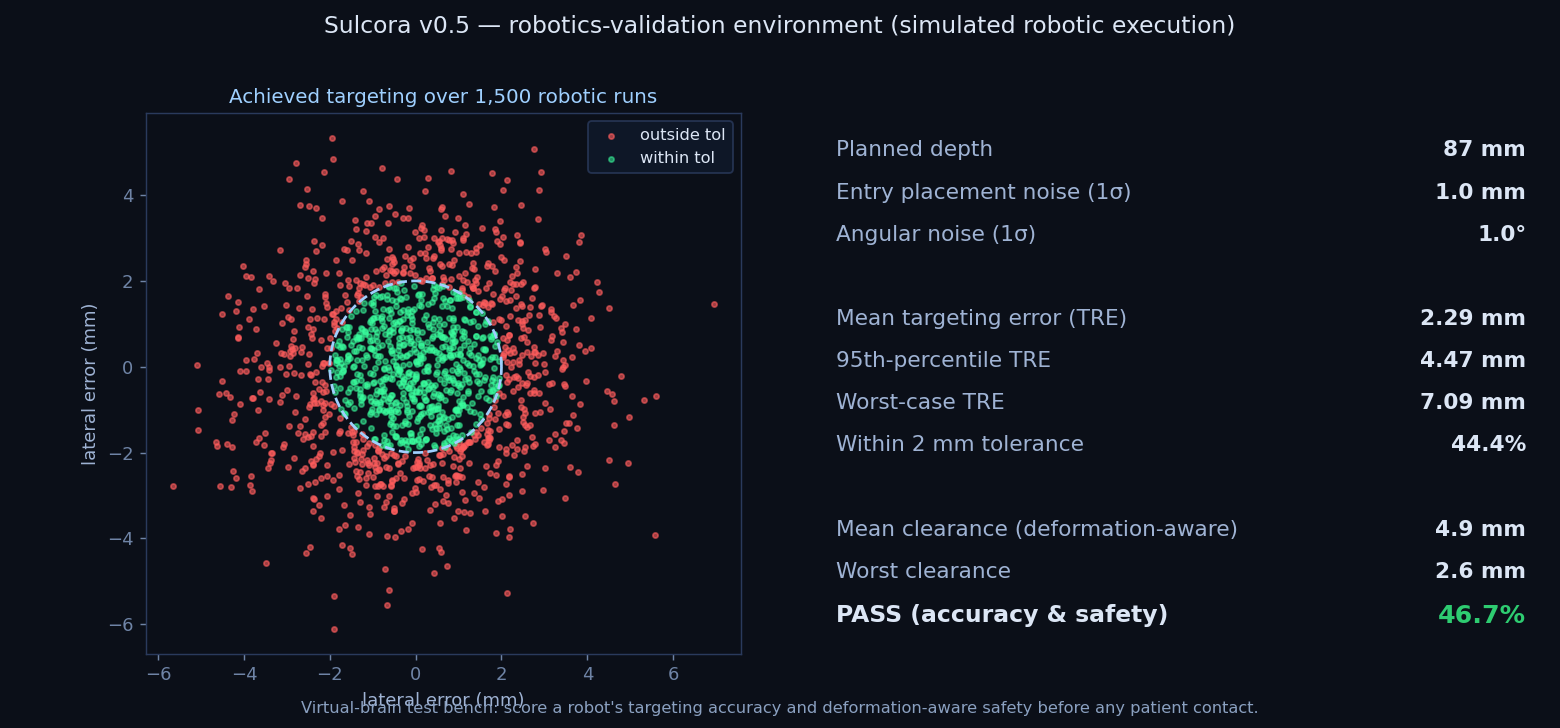
Sulcora robotics-validation bench
Robotics-validation bench: targeting accuracy and deformation-aware safety scored over 1,500 simulated robotic runs.
610+
real SEEG trajectories, 3 institutions
1,500+
simulated robotic runs scored
30
critical structures, incl. tracts
On-device
no image upload
The problem

A single accuracy number doesn't tell you if a trajectory is safe.

Your robot's spec sheet says 0.9 mm. Whether that's good enough depends on the corridor: what lies next to it, how far the brain shifts, and the approach angle. Phantom and cadaver testing answers that for a handful of trajectories, slowly and at high cost. Regulators, hospital value committees and your own clinical team want the answer for all of them.

What you get

A test bench your V&V team can run every day.

ROBOTICS

Corridor-level device qualification

Enter your system's targeting error. Sulcora computes the clearance each trajectory requires, accounting for brain shift and direction, and tells you which corridors your device can and can't reach safely.

🎬

Simulation at scale

About 2,600 entry corridors searched per target, with finite-element tissue deformation and insertion simulation. Thousands of runs where a cadaver lab gives you dozens.

📐

Margins with uncertainty bounds

Every required standoff comes with a computed bound, not a fixed 2–3 mm rule of thumb.

📄

Evidence you can file

PDF run reports, DICOM RT Structure Sets and 3D Slicer exports for verification and validation records and design reviews.

🔒

Vendor-neutral and private

Works with any robot or navigation system. Reads DICOM and NIfTI. Patient images never leave your machine.

Who uses it

Built for the teams that build the robots

R&D and algorithm teams

Building stereotactic robots and navigation.

V&V and test engineers

Verifying accuracy across the full range of trajectories.

Regulatory and clinical affairs

Preparing submissions and design reviews.

Brain–computer interface teams

Planning electrode placement.

How it works

Three steps to a qualification report

1

Load anatomy

Use the built-in public datasets or your own de-identified scans.

2

Enter your device

Targeting error, tool geometry, approach constraints.

3

Run the bench

Sulcora simulates insertions across every candidate corridor and returns pass/fail per corridor, the required margin, and where the risk comes from.

Evidence

What has been tested, and what hasn't.

✓

100% of 610+ real SEEG trajectories

The safety bound held for every real depth trajectory, from 3 institutions, and across 100 real vessel geometries.

✓

610 of 612 evaluations (99.7%)

The bound held on real MR angiography (TubeTK) and a second haemorrhage-CT site (PhysioNet CT-ICH).

✓

All 180 + all 132 evaluations

On the 6-centre COSTA angiography dataset, and on 33 subjects' own diffusion-MRI tracts.

✓

88–96% device qualification

Vendor-neutral qualification pass rates across test sets.

Not yet shown: that Sulcora's planned corridors reduce structure contact compared with a fixed margin on real patient data. That is the subject of the next study. Full results are on the validation page and in the technical package. Sulcora is research software, not a medical device, and is not for clinical, diagnostic or treatment use.
Ways to work with us

Start with a pilot

START HERE

Paid pilot

An 8-week bench evaluation of your system on your use cases, ending in a written qualification report.

Annual bench license

Sulcora for your engineering team, with updates and support.

Custom validation study

A study designed around your submission or your design review.

See the bench run on your use case

Pricing on request · rgoyal@epigenuity.com

Research use

Academic groups

Academic neurosurgery and robotics groups can apply for a free research license. Apply here →